
What Is a Modern…
Breaking into product management can feel confusing when job descriptions…
A small change becomes harder to manage when every feature follows different rules. Without a shared structure, developers spend more time tracing connections and checking what might break. In software development, a modern application framework provides reusable code and conventions that give an application a consistent structure.
Some frameworks focus on the user interface; others handle server-side work or connect both. The label “modern” says little on its own. Understanding what a framework actually provides makes it easier to see where it helps and which responsibilities your team still needs to handle.
A framework gives developers an established way to organise code and handle recurring tasks. Shared patterns can reduce repeated work and make a project easier to understand.
One useful distinction between a framework and a library is control. Application code usually calls a library’s functions when needed. A framework often also decides when application code runs, such as when a request arrives or a screen updates.
Common building blocks include routing, reusable components, and data access tools. Routing directs a request or address to the appropriate handler or view. Reusable components bring related interface elements or behaviour together for use across features.
The exact features vary. A framework for browser interfaces may still need a separate server application. Developers also write the business rules, such as deciding whether a customer can cancel a booking.
Application architecture describes how an application’s responsibilities are divided and connected. A framework influences that arrangement, but it does not make every design decision.
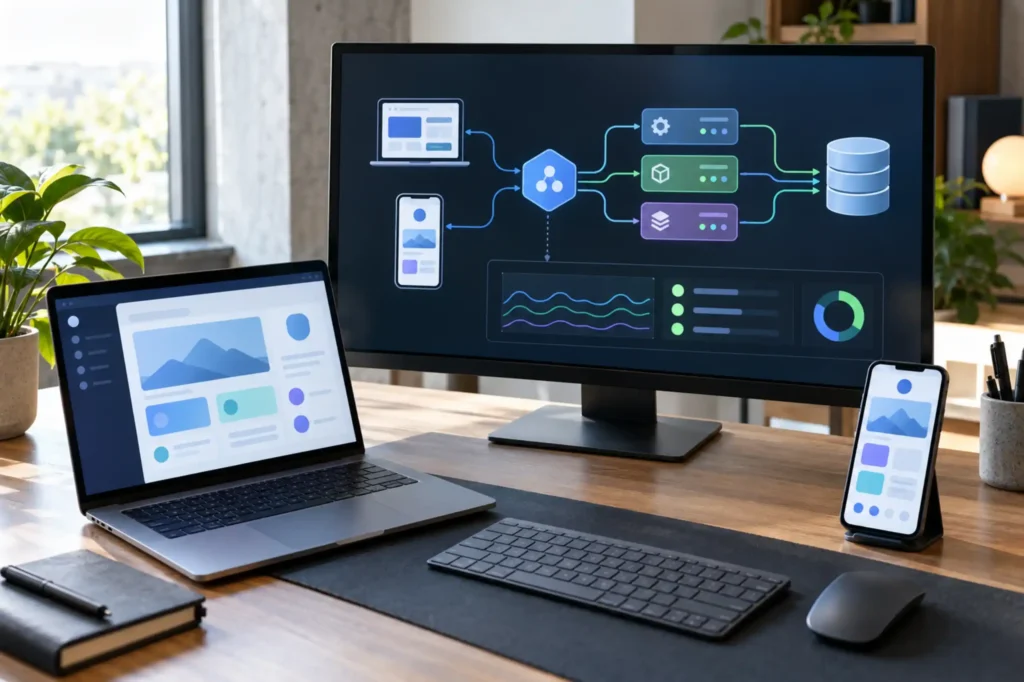
For a web application, a request might pass through a router and middleware before reaching the code that handles it. Middleware performs tasks around request handling, such as logging activity or checking a session. The application then applies its business rules, accesses data where necessary, and returns a response.
Keeping these responsibilities separate helps developers test and change them. For example, a pricing calculation can be tested without opening the screen that displays the result.
An interface follows a related pattern. A user action changes application state, such as the selected booking, and the screen reflects that change. If the action needs server data, the interface must also handle waiting, success, and failure.
Consistent patterns make it easier to follow unfamiliar code. Reusing shared components can also reduce duplication, while automated testing helps check individual rules and interactions between parts.
Those benefits come with constraints. Framework-specific code may take substantial work to move elsewhere. Each additional dependency also adds something the team needs to track, update, and check for compatibility.
A framework does not guarantee a fast or secure application. Slow database queries, unnecessary network requests, or excessive rendering can still affect performance. Permission checks and careful handling of sensitive data remain essential.
Maintenance continues after launch. A framework upgrade can affect application code or connected packages, so dependency management includes testing changes as well as installing updates. The work depends on how closely the application relies on the framework’s features.
A concrete workflow makes these relationships easier to understand. Suppose a customer wants to change a reservation in a booking application.
That is the successful path. The application also needs a clear response when a session expires, the requested slot is unavailable, or a database operation fails.
Failures can occur at different stages. If the reservation is saved but a confirmation email fails, the booking has still changed. Clear status messages help customers understand what happened and avoid submitting the same change again.
Tests can cover these outcomes separately. Checking only whether the booking screen loads would miss much of the behaviour that matters.
Choosing a modern application framework starts with understanding the work your application must do. The important questions concern its users, business rules, data, and likely failure paths. A useful structure makes those responsibilities easier to follow and change.
The framework’s conventions also need to fit the team’s skills and the application’s expected lifespan. Initial development is only part of the commitment.
For your next planning session, use this Ebtechsol guide to map one essential workflow and identify what the framework must support.
No. A programming language provides the syntax and rules used to write software. A framework is code and supporting conventions used with a language to build particular kinds of applications.
Yes. A project might use one framework for its interface and another for its server. The two still need agreed data formats, clear error responses, and appropriate access controls.
No. A small script or simple utility may be easier to maintain without one. Frameworks become more useful when several features need the same patterns for handling recurring tasks.
Full-stack covers both the user-facing interface and the server-side application. It does not mean every required service is included; databases, hosting, and external integrations may still need separate tools.
No. Developers still write business rules, connect services, and handle exceptions. A framework supplies shared mechanisms, but the team must configure them and implement the behaviour specific to the application.
Yes. Some frameworks support mobile development, while others focus on browsers or servers. Supported devices, platform features, and interface behaviour depend on the framework and how the application is built.
An upgrade may change defaults, interfaces, or compatible dependencies. Code that relies on previous behaviour may need adjustments. Installing an update successfully does not confirm that the application works correctly.
No. Reusable components can help teams apply consistent patterns, but accessibility still requires appropriate labels, keyboard support, focus handling, and understandable feedback throughout the finished interface, including error messages.
Costs include development, training, hosting, external services, and ongoing maintenance. Even when a framework has no licence fee, building and operating the application still requires time and other resources.
Sometimes. A separate feature or application layer may allow gradual adoption. If responsibilities are tightly connected, introducing a framework may require wider changes to the existing code and its integrations.
Breaking into product management can feel confusing when job descriptions…

Breaking into product management can feel confusing when job descriptions…


EB Technical Solutions FZE /
EB TECHNICAL SOLUTIONS (PVT.) LIMITED
Copyright © 2026 EBTECHSOL

Ask me anything about AI Automation, API Integration, SaaS Development or our Services.
Just get in touch via text or microphone.